
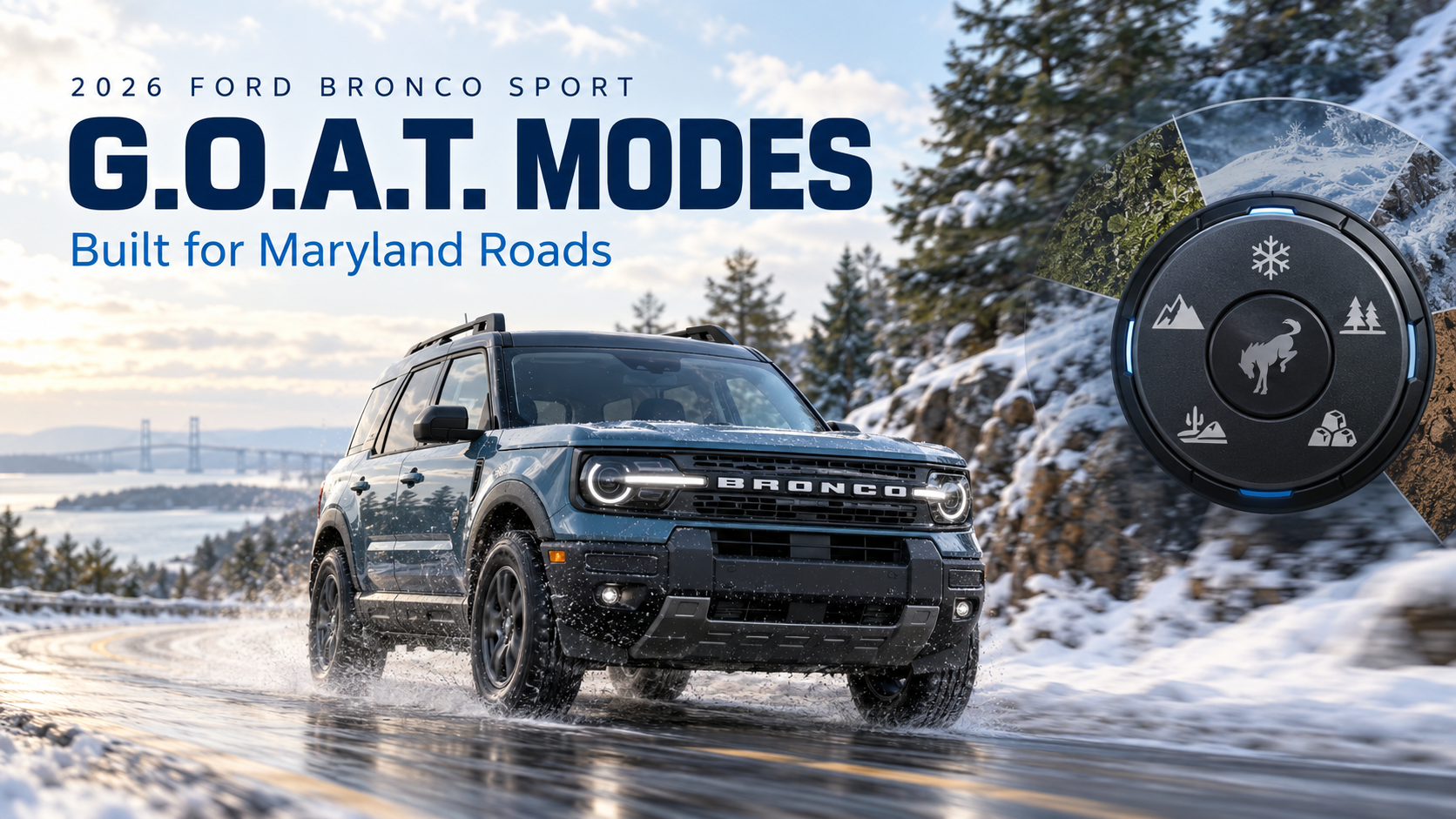
Picture a February morning on Route 198. Overnight sleet turned the shoulder to slush, and the ramp onto I-95 is a sheet of gray. Your Bronco Sport has a dial on the console with seven letters and a goat head, and you have about four seconds to decide what it does. Most drivers never touch it. We sell Bronco Sports to Laurel families, Fort Meade commuters, and weekend trail seekers every week, and this dial is one of the most common questions on our lot. Ford’s G.O.A.T. Modes system stands for “Goes Over Any Type of Terrain” and adjusts throttle response, transmission shift points, traction control, and all-wheel-drive behavior with one turn of the console dial. This guide explains every mode, which trims include which, and exactly when to use each one in Maryland conditions.
How Do Ford Bronco Sport G.O.A.T. Modes Actually Work Off-Road?
G.O.A.T. Modes are drive modes that retune the Bronco Sport’s engine, transmission, all-wheel drive, traction control, and stability control from one console dial. The name stands for Goes Over Any Type of Terrain. You turn the dial, the vehicle re-maps how it delivers and distributes power, and you keep driving.
The short answer
The Bronco Sport’s G.O.A.T. Modes adjust throttle response, shift timing, AWD torque split, and traction control thresholds to match the surface under the tires. Normal, Eco, Sport, Slippery, and Sand are standard across trims. Mud/Ruts and Rock Crawl are exclusive to the Badlands. Drivers select modes on the fly at low speeds — no stopping, no manual 4x4 lever.
What is the dial actually changing?
Each mode is a software package, not a mechanical lever. Selecting Slippery softens throttle tip-in and lets traction control intervene earlier. Selecting Sport holds gears longer and sharpens pedal response. The Bronco Sport’s all-wheel-drive system is always available in every G.O.A.T. Mode — the mode changes how aggressively torque moves front to rear, not whether AWD exists.
❌ Myth: You have to engage 4x4 separately before using a G.O.A.T. Mode.
✅ Reality: Every Bronco Sport ships with standard all-wheel drive engaged automatically. The dial only tells the system how to behave.
Our take at Academy Ford
In our work with Fort Meade commuters and weekend adventurers from Howard County, we’ve found most owners use two modes all year — Normal and Slippery. The Academy Ford Two-Dial Rule is our guidance that drivers should master Normal and Slippery first, then learn the specialty modes only for the terrain they actually encounter. Our product specialists walk through the dial in person on every Bronco Sport test drive in Laurel, MD.
Slippery vs. Mud/Ruts: What’s the Real Difference?
Slippery Mode is built for low-traction surfaces where you want the vehicle to stop wheelspin immediately — wet pavement, packed snow, slush, black ice. Mud/Ruts Mode does the opposite: it allows wheelspin, because clearing mud from a tire tread requires rotation. One restrains the wheels. The other frees them.
Which one for which surface?
| Factor | Slippery Mode | Mud/Ruts Mode |
|---|---|---|
| Designed for | Ice, snow, slush, rain-slick asphalt | Deep mud, rutted trails, soft soil |
| Wheelspin | Suppressed aggressively | Permitted and encouraged |
| Throttle response | Softened, gradual | Sharper for momentum |
| Availability | All 2026 trims | Badlands only |
| Typical MD use | I-95, Route 198, Route 29 in winter | Western Maryland trails, farm lanes |
Mud/Ruts Mode on the Bronco Sport Badlands pairs with the twin-clutch rear drive unit, which can lock torque to a single rear wheel. That hardware is what makes ruts survivable. Big Bend and Outer Banks trims do not offer Mud/Ruts, and for the overwhelming majority of Central Maryland driving, they don’t need it.
Do most Maryland drivers need Mud/Ruts?
Based on our experience matching Laurel, Columbia, and Bowie families with Bronco Sports, drivers who stay on pavement and gravel get everything they need from Slippery and Sand. Buyers hauling kayaks to Patapsco Valley or camping in Garrett County are the ones we steer toward the Badlands.
That trim decision is exactly the conversation we like having face-to-face. Come sit in both on our Laurel lot — no pressure, no script, and our bilingual team can walk you through it in English or Spanish.
How Does the Bronco Sport Handle Maryland Winter Slush and Ice?
The Bronco Sport handles Maryland winter conditions well because standard all-wheel drive is paired with Slippery Mode on every trim. Slippery Mode reduces throttle sensitivity and tightens traction control, so the tires bite before they spin. On slush-covered I-95 or a refrozen Route 198 shoulder, that combination matters more than horsepower.
Why Slippery Mode beats Normal on freezing rain
Freezing rain produces the lowest-traction surface a Maryland driver will meet all year. In Normal Mode, a heavy right foot can break the front tires loose before stability control reacts. Slippery Mode moves that intervention point earlier and blunts the throttle curve, which is why we recommend selecting it the moment precipitation starts — not after the first slide.
- Select Slippery before you leave the driveway, not mid-slide.
- Increase following distance to at least six seconds.
- Brake and steer as separate actions, never simultaneously.
- Switch back to Normal once pavement is dry and clear.
What we recommend maintaining before winter
Our Service team inspects rear drive unit fluid, tire tread depth, and battery health ahead of each Maryland winter. Road salt across Prince George’s and Anne Arundel counties accelerates undercarriage corrosion, so we also recommend routine underbody washes. Schedule a pre-winter check with our Laurel service department.
Which G.O.A.T. Mode Should You Use for Rocky Trails in Western Maryland?
Winter slush is one challenge. Loose rock at Green Ridge State Forest or the fire roads off Savage River is another entirely.
For rocky trails in Western Maryland, use Rock Crawl if your Bronco Sport is a Badlands, and Sand if it isn’t. Rock Crawl locks in the lowest usable gear, sharpens throttle response at crawl speed, and holds the twin-clutch rear drive unit ready to shuffle torque side to side.
What if my Bronco Sport doesn’t have Rock Crawl?
Sand is the correct substitute on Big Bend, Heritage, and Outer Banks trims, since Mud/Ruts is Badlands-exclusive too. Sand loosens throttle mapping and softens traction-control intervention for loose, low-grip surfaces, which is the closest those trims get to Mud/Ruts’ wheelspin-friendly calibration on a rocky climb. In our experience with weekend adventurers driving out I-70 toward Cumberland, the bigger mistake is mode-independent: too much speed.
Our three-step approach to a rocky ascent
- Stop before the obstacle, shift to a low speed, then turn the dial to Rock Crawl or Mud/Ruts.
- Let the SUV idle forward. Steady throttle beats stabbing at the pedal.
- Pick a line that keeps one tire on solid rock at all times.
Badlands owners also get one advantage no mode can replace: real underbody protection. If Western Maryland trails are part of your plan, tell our team before you test drive. We’ll put you in the trim that actually matches the terrain rather than the one that’s easiest to sell.
Which 2026 Bronco Sport Trims Include Rock Crawl and Rally Modes?
Trim determines which modes appear on your dial — that’s the detail most online guides skip. Rock Crawl and Rally are exclusive to the 2026 Bronco Sport Badlands. Every other 2026 Bronco Sport trim — Big Bend, Heritage, and Outer Banks — comes with five G.O.A.T. Modes: Normal, Eco, Sport, Slippery, and Sand. Badlands adds the sixth and seventh.
Trim-by-trim G.O.A.T. Mode comparison
| Mode | Big Bend | Heritage | Outer Banks | Badlands |
|---|---|---|---|---|
| Normal | ✅ | ✅ | ✅ | ✅ |
| Eco | ✅ | ✅ | ✅ | ✅ |
| Sport | ✅ | ✅ | ✅ | ✅ |
| Slippery | ✅ | ✅ | ✅ | ✅ |
| Sand | ✅ | ✅ | ✅ | ✅ |
| Mud/Ruts | — | — | — | ✅ |
| Rock Crawl | — | — | — | ✅ |
| Rally | — | — | — | ✅ |
Confirm mode availability against the window sticker on the specific vehicle, since Ford occasionally revises content mid-year.
Which trim is best for Central Maryland snow commuting?
For snow commuting around Laurel, Columbia, and Fort Meade, Outer Banks is our most recommended trim. Slippery mode is standard across the lineup, so Badlands offers no winter-specific advantage on paved roads. What Outer Banks adds is heated seats, a heated steering wheel, and remote start — the features you actually use in February.
❌ Myth: You need Badlands to drive safely in Maryland winters.
✅ Reality: All 2026 Bronco Sport trims include standard 4x4 and Slippery mode. Badlands exists for terrain, not weather.
We’d rather save you the upgrade. Ask our bilingual sales team to walk both trims side by side on our Laurel lot — no pressure, no hidden fees, and military pricing available for Fort Meade personnel.
How Do G.O.A.T. Modes Affect Real Fuel Economy on the I-95 Commute?
Trim choice affects your sticker price. Mode choice affects what you spend every week at the pump on Route 1.
Eco mode delivers the best real-world fuel economy on the I-95 corridor, while Sport, Mud/Ruts, and Rock Crawl consistently reduce it. Eco softens throttle mapping, shifts the transmission earlier, and moderates climate-control draw. Sport does the opposite — it holds gears longer and keeps the engine at higher RPM.
Which mode costs you the most MPG?
Off-road modes are the most expensive to leave engaged. Mud/Ruts and Rock Crawl keep the rear drive unit more actively involved and permit wheelspin, both of which burn fuel with zero benefit on dry pavement. Refer to the EPA estimates on your window sticker for official figures; those ratings reflect standard testing, not sustained Sport-mode driving.
- Eco — best MPG, ideal for the Laurel-to-Baltimore crawl
- Normal — balanced default for mixed surface streets and highway
- Slippery — negligible MPG penalty; safe to use all winter
- Sport — noticeably thirstier, best saved for merging onto the Beltway
- Sand / Mud/Ruts / Rock Crawl — meaningful MPG loss on pavement
Our habit for daily commuters
In our work with I-95 daily commuters, the pattern is consistent: drivers who default to Eco and reach for Slippery only when conditions demand it report better mileage than drivers who never touch the dial at all. The dial resets to Normal at each start, so make selecting a mode part of your morning routine — right after the seatbelt.
Fuel economy also depends on maintenance. Our service team in Laurel checks tire pressure, air filters, and alignment, all of which quietly cost you MPG.
What Maintenance Does the Bronco Sport Twin-Clutch Rear Drive Unit Actually Need?
Rock Crawl and Rally hardware only stays sharp if the hardware underneath gets serviced. The Bronco Sport twin-clutch rear drive unit requires periodic fluid replacement, and Ford specifies the service interval in the Scheduled Maintenance section of your Owner’s Manual — typically tied to mileage and severe-duty use rather than years. Beyond fluid, the unit needs no adjustment, no belts, and no filters.
The twin-clutch rear drive unit is the rear differential on Badlands-trim Bronco Sport models that uses two independently controlled clutch packs to send torque to either rear wheel individually, enabling torque vectoring and the 100 percent lock that Rock Crawl and Mud/Ruts depend on. Because it carries its own fluid and its own electronic actuators, it is a distinct service item from the front differential and transmission.
Does Maryland winter count as “severe duty”?
For many of our customers, yes. Ford’s severe-duty schedule covers frequent short trips, sustained low-speed operation, off-road use, and driving in road salt — which describes a Laurel-to-Fort-Meade winter commute precisely. In our service lane, we see road salt and brine spray do more cumulative damage to underbody driveline components than trail use does.
Our Service team handles this with Genuine OEM Ford fluids — schedule it in Laurel and we’ll walk you through what we found, in English or Spanish.
How Is Maryland’s 6.5 Percent Vehicle Excise Tax Calculated on a New Bronco Sport?
Service costs are predictable. So is Maryland’s tax, once someone shows you the math. Maryland charges a vehicle excise titling tax of 6.5 percent of the taxable purchase price on a new vehicle. The Maryland Motor Vehicle Administration calculates it from the negotiated price shown on the dealer’s bill of sale, minus the allowance for a trade-in.
What counts toward the taxable price?
Three things move the number. First, the agreed sale price of the Bronco Sport. Second, the trade-in allowance, which is subtracted before tax is applied in Maryland. Third, manufacturer rebates and dealer discounts, which reduce the price the tax is figured on when they’re applied as a price reduction rather than cash back.
| Line item | Effect on excise tax |
|---|---|
| Negotiated vehicle price | Tax base — 6.5% applies |
| Trade-in allowance | Subtracted from tax base |
| Manufacturer rebate applied to price | Reduces tax base |
| Title, tag, and MVA fees | Not part of the excise base |
| Extended service contracts | Generally excluded |
❌ Myth: The excise tax is calculated on MSRP.
✅ Reality: Maryland’s excise tax is based on the actual purchase price documented on the bill of sale, which is why a real trade-in and a real discount both lower what you owe.
Why we put this on the worksheet first
We’ve been family-owned in Laurel since 1962, and transparent pricing means the tax line isn’t a surprise on signing day. Our team writes out the sale price, your trade allowance, the 6.5 percent excise figure, and MVA fees before you commit to anything.
Military personnel near Fort Meade should also ask us about our Military Discount — it applies to the vehicle price, which shifts the tax math in your favor. Come drive a Bronco Sport and we’ll build the full number with you, no pressure, in English or Spanish.
Conclusion
| 📌 Key Takeaway | Why It Matters |
|---|---|
| Slippery mode is the Maryland default, not Rock Crawl | Slush and ice dominate local winter driving |
| G.O.A.T. Modes retune software, not hardware | Standard 4x4 is already doing the work |
| Badlands adds twin-clutch rear drive unit | Unlocks Rock Crawl and true trail capability |
The 2026 Bronco Sport’s G.O.A.T. Mode dial is a software layer that retunes throttle, shift logic, traction control, and 4x4 torque split for the surface under the tires. For most drivers between Laurel and Baltimore, Slippery and Normal handle the entire year, while Badlands buyers gain Rock Crawl and the twin-clutch rear drive unit for Western Maryland rock and mud. Our view after 60-plus years in Laurel is simple: pick the trim that matches how you actually drive, not the one with the longest mode list.
Academy Ford has been family-owned in Laurel, MD since 1962, and our product specialists will walk you through the dial in a real 2026 Bronco Sport before anyone talks numbers. Browse our current Bronco Sport inventory or schedule a test drive, and ask about our Military Appreciation program if you’re stationed near Fort Meade. You’ll leave knowing exactly which modes come with your trim, what your out-the-door price is, and why we quote it with no hidden fees. Se habla español.
? Frequently Asked Questions
5 questions optimized for rich results.
Generated September 15, 2026 · IntentNexus Content Package